


GNFO
-
Posts
120 -
Joined
-
Last visited
-
Days Won
6
Content Type
Profiles
Events
Forums
Gallery
Downloads
Community Map
Everything posted by GNFO
-

Hisun Sector e1 Battery replacement: any tips?
GNFO replied to didgeridoo's topic in Hisun UTV SxS Forum
Yeah, from that document I did the figure 3 balanced charging as opposed to the figure 3 "perfectly" balanced charging. While conceptually I get that the "perfectly" is a little better, it is also more complicated to set up since you have to work out the resistances of the cable runs and any connections. In this case just balanced charging is good enough. Another thing to keep in mind is that it's a bigger issue with "dumb" lead-acid batteries. Each of the new LiFePO4 batteries has their own smart BMS to help manage balances, plus parallel in general helps balance out batteries vs the serial setup Hisun used with the awful Discover 6V batteries. I did use equal length brand new 1/0 AWG cables for my connections except for re-using the two final cables that connected to the motor controller. -
Hisun Sector e1 Battery replacement: any tips?
GNFO replied to didgeridoo's topic in Hisun UTV SxS Forum
It will probably work, and you may never run into a problem, but generally I've seen that you want equal length cables so the resistance is the same, and for parallel either run from one to the next (e.g. B-A-D-C for negative in your diagram and vice versa for positive) or run them all to a bus bar. The way you have it set up, some are connected directly. With in your example, the negative terminal at B being sort of a bus bar, but then C is connected to D. My four batteries are set up in the same trays you show, and I did the Motor Controller (MC)-B-A-D-C for negative, and MC-C-D-A-B for positive. I kept the Delta Q charger, which charges through the motor controller, so I didn't have the extra connection to a charger, but again I would connect that to the last in line of the set; either the same as the motor controller, or perhaps the opposite ends since the terminals can get a little crowded. -
Hisun Sector e1 Battery replacement: any tips?
GNFO replied to didgeridoo's topic in Hisun UTV SxS Forum
Just to be clear, all of these lithium batteries have a BMS. Where it differs is the charging/discharging rate they allow and if they communicate amongst themselves to coordinate things like discharge/charge leveling among multiple batteries. Based on the label I see in the picture, yours have a max continuous discharge current of 60A as opposed to the 80A version. That just means that with four batteries your max continuous output is 240A, although they will be able to put out more for a limited time up to the 400A max of the motor. A number of folks on this thread have similar batteries and they are happy with them. It helps that Hisun set the bar rather low by using those Discover batteries; pretty much anything is better than those. -
Hisun Sector e1 Battery replacement: any tips?
GNFO replied to didgeridoo's topic in Hisun UTV SxS Forum
Glad you were able to work it out. Out of curiosity, I don't see any hold-downs in your pictures. Did you add some afterwards (I hope)? I had to modify mine somewhat due to the different top configuration vs the old Discover batteries. -
Hisun Sector e1 Battery replacement: any tips?
GNFO replied to didgeridoo's topic in Hisun UTV SxS Forum
Should generally be fine, although I'm guessing you saw that the minimum operating temperature is -4F. I've found that the batteries don't heat up during discharge as much as you might think, which is normally a good thing unless you're at -10F! Guessing that isn't the norm though, so maybe you could get away with just plowing a little later in the day when it's really cold. If you really wanted to be safe, you could get a simple heating mat run off the 12V side and put that on top, but I wouldn't worry about that until you come across those conditions (snowing and extreme cold at the same time). I also see that the max continuous output is 80A. Pushing a plow can be heavy work, so definitely want at least the four batteries you're planning. Max output of the UTV motor is 400A. Others on this thread have been fine with lower total outputs of their batteries, probably because the times they need the highest output fit within the time-limited specs (e.g. XXXA for 30sec.), but if you can afford it, more is better. I used four because my batteries have a 100A continuous output rating, but they were also quite expensive at the time (pretty much the only viable GC2 option back then really). Even then I would have put in more if they had been cheaper since that also increases the total capacity. I've still never gone below 70%, but again, more is better! My opinion, for what it's worth, is get at least five, especially for the price those batteries are right now. -
Hisun Sector e1 Battery replacement: any tips?
GNFO replied to didgeridoo's topic in Hisun UTV SxS Forum
Best of luck! There are a lot more options now than when I did mine 3 years ago, and of course they've also come down a lot in price. 1. Didn't have any issues with disconnecting, but since lead acid batteries are always "on" try not to short circuit anything. The motor controller won't be on, so it's pretty safe and each Discover battery is only 6 volts anyway. Regarding connecting, the nice thing about the modern LiFePO4 batteries is that they have a smart BMS and you can actually turn them off. They'll come that way anyhow. So no danger of current flow until you specifically turn them on. 2. Depends on your setup. Some use a busbar connected to each battery, while I used the standard one battery connected to the next like the manufacturer suggested. For that standard one-to-the-next connection, if you're going to use a different charger then I'd still connect the charging cables to the end of the line same as the motor controller. I used the existing onboard charger and changed the profile. The Delta-Q is still a good charger and of course the charging current flows back through the motor controller anyway. 3. If you're really worried there are specific low-temperature LiFePO4 batteries, but all of them are generally just fine discharging even well below freezing (unless you're someplace really crazy like northern Canada, in which case you should check the battery's specifications.) It's charging where you have to be careful about being above freezing. So as long as you charge in the garage and you're sure the batteries aren't cold-soaked below freezing from being outdoors, you're fine. Even then, a reputable battery with a good BMS will prevent trying to charge below freezing anyway. I finally installed a plow this year and haven't had a chance to really use it, but that's how I'm set up as well. -
Another conversion to Lithium (and a few questions)
GNFO replied to gridlock's topic in Hisun UTV SxS Forum
Mine had a custom profile the battery manufacturer created specifically for them, but if you look through some of the other E1 conversion threads here you'll see the links to the Delta-Q pages showing the steps and some of the others here I think listed what stock profile they used. Regarding your particular setup, since your battery has max continuous output of 200A vs the 400A max of the motor, just keep in mind that some folks have had problems with the motor cutting out because of the draw. I think it totally depends on the how the battery handles it and what the motor controller sees in the voltage as a result, and what their time-limited amperage draw specs are, so you may be just fine. Most have no problems. If you do encounter a problem remember that it could be related to that. I believe the person who had a problem added a second battery in parallel and it went away. -
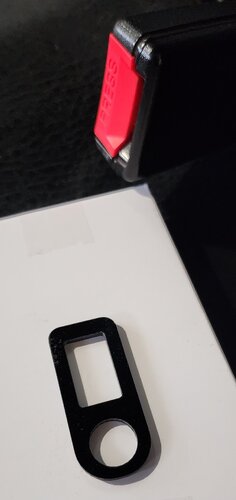
View File Hisun/Axis seatbelt defeat/bypass This file is for using a laser cutter to cut a dummy seatbelt tongue to override the seatbelt warning and speed limiter. I used 3mm thick acrylic. My laser is an XTool, so I included the .xcs file for that brands software, but also included a generic vector file .svg. Probably want to verify the dimensions translated properly for your cutter before using. My UTV is an Axis E1, which is basically a rebranded Hisun Sector E1, and I'm also guessing that all the Hisuns probably use a common seatbelt anyway. Use only where appropriate and at your own risk. Submitter GNFO Submitted 03/10/2026 Category Hisun
-
0 downloads
This file is for using a laser cutter to cut a dummy seatbelt tongue to override the seatbelt warning and speed limiter. I used 3mm thick acrylic. My laser is an XTool, so I included the .xcs file for that brands software, but also included a generic vector file .svg. Probably want to verify the dimensions translated properly for your cutter before using. My UTV is an Axis E1, which is basically a rebranded Hisun Sector E1, and I'm also guessing that all the Hisuns probably use a common seatbelt anyway. Use only where appropriate and at your own risk. -
I know this is an old thread, but like you I was looking for a way to bypass the seatbelt safety switch. We have a long driveway and putting on the seatbelt seems silly when there is no chance of traffic or bumps and turns. I pretty much only use my E1 on my property and any place where I could get into trouble I wouldn't be going that fast anyway. I saw the 3D file in the downloads but I don't have a 3D printer. However, I do have a laser cutter and the shape of the seatbelt tongue is basically just a flat piece anyway. So I generally copied the look of that 3D piece, but measured the existing tongue of the seatbelt and cut it out of 3mm black acrylic. You can see the results and it works just fine. I was prepared to lightly sand the straight edges to round them like the buckle, but it turns out that's not necessary. The moment I stuck it in the buckle the seatbelt warning went out and problem solved. I have an XTool laser, so I included the .xcs file for that, but I also included a more generic vector file .svg. Verify the dimensions of the .svg before you cut to make sure it translated properly. Hisun seatbelt latch.xcs Hisun seatbelt latch.svg

-
Powers up, but will not engage in forward or reverse
GNFO replied to CKfrustration's topic in Hisun UTV SxS Forum
Well, doesn't sound good. If you can hear a whirring then the motor if probably good, so that leaves the Main Gearcase. Seems like this post might help: "Replacement Main Gearbox for Sector E1". But probably want to take it apart and verify before you spend any money on it though. -
Hisun e1 2021 cuts power after a few yards
GNFO replied to Jamesshoop1's topic in Hisun UTV SxS Forum
Good to hear. Wondering if those batteries don't quite meet their specs for immediate power demand, so the voltage drops when a demand is made. Having two might be allowing you to compensate for that. That's one of the reasons I tried to make sure my batteries could accommodate a continuous output at max amps rather than try and live in the time-constrained margins. It's more expensive, but probably avoids some issues in the long run. -
View File Axis E1 UTV Owners Manual Axis E1 is a 48V all electric UTV. It is a rebranded Hisun Sector E1 and is mechanically the same except for some cosmetic differences. Submitter GNFO Submitted 02/05/2026 Category Other UTVs
-

2 downloads
Axis E1 is a 48V all electric UTV. It is a rebranded Hisun Sector E1 and is mechanically the same except for some cosmetic differences. -
Hisun e1 2021 cuts power after a few yards
GNFO replied to Jamesshoop1's topic in Hisun UTV SxS Forum
He's checked all of that, and the consistent timing of the cutoff doesn't seem consistent with a marginal connection, especially when it happens with no vibration (I think he's lifted it and run with the wheels off the ground.) -
Hisun e1 2021 cuts power after a few yards
GNFO replied to Jamesshoop1's topic in Hisun UTV SxS Forum
Thanks. Have you ever come across the problem Jamesshoop1 is describing? Considering it started even under the old Discover batteries, it doesn't seem like his new battery could solely account for the problem, although it may be contributing. Which is also intermittent again apparently. -
Hisun e1 2021 cuts power after a few yards
GNFO replied to Jamesshoop1's topic in Hisun UTV SxS Forum
Just as an FYI, my "48V" batteries are advertised as putting out 51.2V just like the advertisement says for yours. The inverter I have connected to the pack says that it is actually putting out 52.1V. I think I've seen others with higher voltage; one of the pictures shows 54.1V on their readout. -
Hisun e1 2021 cuts power after a few yards
GNFO replied to Jamesshoop1's topic in Hisun UTV SxS Forum
As currently configured I'm not sure. I know that @EVSupport actually reprograms the Sevcon as part of his professional upgrades and actually puts higher voltage through the system (~60V?). I don't know if part of that reprogramming touches on maximum allowable voltage, but maybe he can shed some light on how the Sevcon is originally configured and how it might act. -
Hisun e1 2021 cuts power after a few yards
GNFO replied to Jamesshoop1's topic in Hisun UTV SxS Forum
While I agree the battery doesn't make the best use of the motor, his battery model is specified for 200A for 120 seconds, 360A for 10 seconds, and 600A for 1 second. It shouldn't be cutting off because of the BMS at 5 seconds under a light load unless there is either a problem with the BMS or the problem is external (e.g. the Sevcon). Especially if it was happening before he did the lithium conversion, too. At any rate, that is why I was asking if the additional external monitor that comes with the battery flagged any BMS errors. -
Hisun e1 2021 cuts power after a few yards
GNFO replied to Jamesshoop1's topic in Hisun UTV SxS Forum
Again, just speculating, but given that this has happened under both the original batteries and the replacement LiTime battery, unfortunately I'm thinking there's a problem with the Sevcon motor controller. Despite the max 120s output being only 200A, there are others here who have operated just fine under the same limitations. If you can also verify from the monitoring screen that there are no battery BMS errors when it cuts off, that might also suggest a problem with the Sevcon. Maybe the screen can also show what the output parameters are right before shutdown (V, amps)? -
Hisun Sector e1 Battery replacement: any tips?
GNFO replied to didgeridoo's topic in Hisun UTV SxS Forum
There are a lot of factors in play. This thread has been going on for almost four years and the availability of replacement batteries has increased quite a bit over that time. What country you're in comes into play, too. We have people from Europe/UK, Canada, US, and Australia and the available selection can be very different. Those in the US seem to have the greatest number of options. I did my conversion almost three years ago and at the time there were very few GC2 form-factor lithium batteries in the US market, and really only one maker that had 48V batteries with a high enough constant amp output to match the Hisun motor. You could probably spend anywhere from $1,500-$5,000 US depending on what combination of amp output, capacity, and form factor you're looking for. GC2 form was important to me so I could just drop in replacements without customizing the tray to hold a physically larger size battery, but some of the conversions here did do just that. You'll pay more for batteries that have cross-BMS connections so all the batteries "talk" to each other to optimize output and charging, but depending on your use that may not be necessary with batteries connected in parallel. Gorj got to 48V using 12V batteries wired in serial, I and a number of others went with 48V batteries and went for increased amp output and capacity by using (generally) four GC2 form factor batteries. Some of the conversions just used one or two very large form factor batteries. Most of us also added a digital readout. You just have to weigh your own local battery availability, cost, ability to customize, time, performance needs, and how long/far you want to be able to go between charges (capacity). For me, four 48V batteries that combine to 120ah and a continuous output rating of 400A has been great on my 6 acres of wooded property with lots of uneven ground and some fairly steep hills. I never get below ~70% in a day even when running a 120V inverter for power tools, but I also get to plug in the evening. If you plan on going far into the wild for a few days then of course you will need more capacity. If that includes heavy loads and steep hills you want to make sure your amp output is at least 400A. By going with the 48V GC2 form batteries, I reasoned that if I later found I needed more capacity I could easily just add more batteries in parallel. I've found those four have been enough for me, but I can see how others would need more. The good news is that there are a lot more options now than years past and you can customize your solution to you. -
Hisun e1 2021 cuts power after a few yards
GNFO replied to Jamesshoop1's topic in Hisun UTV SxS Forum
Don't really know what could cause it, but perhaps try checking the fuses? Seems unlikely, but perhaps there is a partial failure mode where it is warming up just enough to gap. -
Instrument and switch panel stopped working - Sector E1
GNFO replied to Jarheadtx's topic in Hisun UTV SxS Forum
It looks like that 30A fuse sits between the main pack battery and the DC/DC converter, so if there had been a surge, it seems like it's your converter that would have fried instead of the panel. From the wiring diagram it seems like you should have more live wires in the connector to the panel, but without the main packs in I'm not sure if they would be live. The wiring diagram is the second to last page of the service manual. 2015-2017 Service Manual - Sector E1.pdf -
Instrument and switch panel stopped working - Sector E1
GNFO replied to Jarheadtx's topic in Hisun UTV SxS Forum
Complete guesswork here, but going with the easiest first - have you checked your 12V battery or replaced it? The items you mentioned are 12V driven I believe, and since the main pack constantly charges the 12V battery through the DC/DC converter it can hide the fact that the 12V is dying. Is there a chance the battery has never been changed an maybe it just got to the point where it couldn't drive the lights anymore but can still muster enough current to start the UTV initially? The only way to check the battery is turning off the 48V batteries themselves (if they have that function on each of them like mine) or completely disconnecting the 12V, and then checking the voltage. When I did that, I found out my battery was at 6V when it wasn't being propped up by the main pack. I didn't have any errors though. If it isn't that, looking at the wiring diagram it gets more complicated and all I can suggest is follow the wiring diagram from the 12V back to the combination instrument (the display). -
I'm not an expert since my Discover batteries were not great to begin with, but from Discover's own published specs: Self-Discharge (@20°C): 2-3% per month Charge Temperature: -10°C to 50°C Discharge Temperature: -40°C to 50°C Storage Temperature: -20°C to 60°C You don't specifically say if it will be stored outside or in a non-climate controlled space that can get down to the outside temperature, but I'm guessing you're implying it, so the storage temperature limitation might be an issue, and maybe the charge temperature as well if you are topping the batteries up. If you can leave it plugged in, it will periodically top the batteries up on it's own, or you can use a 48V trickle charger if you prefer. If you have to leave it in temperatures below the limitations, you could maybe get an automatic heating mat. Other than that or in a garage, your only other alternative would be pulling the batteries. I wouldn't envy you that - each one of those bad boys is 65lbs/29.5kg and there are eight of them.