
Quantcast
Jump to content


Recommended Posts

Posted

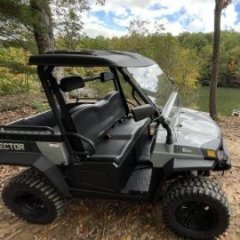
New to the forum. New to UTVs. New to Electric motors.  I just got a 2021 Hisun Sector E to help with moving stuff on my  steep 5 acre wooded mountain patch. Plus I thought it would be fun on the gravel roads in the "neighborhood". Because we are remote and part time to the property, I didn't want the hassle of dumping out old gas or messing with oil and filters and all the usual maintenance of a ICE. But the biggest reason for me was the noise. I test drove the Axis utvs at Tractor Supply Co and they were LOUD. Seemed to ride rough too. If you want quiet, then electric is the way to go. But it does come with a high price tag. And all the electric models are still in their infancy. So its a bit of a gamble too. I bought the property for quiet. I wanted to keep it quiet.

I liked that the Hisun had the dry cell batteries so there is no maintenance of checking and adding water. I'm a little worried about their lifespan especially after one person's poor utube review about them. But the dealer said the company took that to heart so hopefully changes were made for better batteries. There were no Lithium battery options available anywhere near me. Polaris is supposed to have one later this year. I liked that the Hisun came standard with roof, windshield, winch and trailer hitch. I have had the sector for only one day and worked it and road it good. So far I have a big smile on my face. I wish there was a category for this model on the forum here. Meanwhile, maybe folks will share their insights/ experiences on this thread. I'd like to learn as much about the sector e as I can. There isn't much info in the owners manual.


IMG-1398.jpg

  • Alex changed the title to 2021 Hisun Sector e (its electric)
Posted

I have a 2017 Hisun  Sector e.   It is the most frequently used vehicle (including cars) on our property.    I love the fact it is relatively maintenance free, and you can just get in it and go.... any time, any weather.   Looking at your picture I can see they haven't changed much in the last 4 years (tires and decals looks to be it).   I don't think I would like my rig for going exploring out in the woods because of it's limited range, but it is perfect for around home.    My batteries are getting worn and don't provide the miles that they used too, but I plug it in every night and it will still easily last a full day for whatever I may choose to do.    I only have a couple of minor complaints; 1) the long delay between turning on the key and the time you can put it in forward or reverse to go.  If you put it in forward or reverse too soon it just sets there until you put it in neutral for several seconds the go into forward or reverse.    Whenever someone new drives it for the first time they can't make it go because of this quirk.   No one will ever steal it because of this  😊  2) the emergency brake doesn't always release fully and I sometimes have to pull it up a little further with my toe before it will go.   Hopefully they have corrected those minor issues on the new ones

Posted

When new take it easy and light usage for about 20 charge cycles, if you do the life of the batteries will be longer. If you thrash it from new and heavily deplete the battery pack the life will be significantly shortened. Check all the battery and power connections regularly for tightness.  I do Li ion conversions on these in the UK, and all have huge amounts of crud under the seats between and down the side of the batteries, as well as under the floor in the drive tunnel hump.  It helps to clear that out regularly. The small belly pan can be dropped of and let some of the stuff out, but you have to lift the floor / tunnel to get that out.  I also change the bolts that hold the belly pan for std (although stainless) m6 screws, as for some reason they use screws with small heads, that easily wring round. Only use 6 point sockets on the originals, 12points will round off much easier.  Occasionally check that the fan on the charger at the front hasnt got clogged up with mud.


Posted
4 hours ago, EVSupport said:

When new take it easy and light usage for about 20 charge cycles, if you do the life of the batteries will be longer. If you thrash it from new and heavily deplete the battery pack the life will be significantly shortened. Check all the battery and power connections regularly for tightness.  I do Li ion conversions on these in the UK, and all have huge amounts of crud under the seats between and down the side of the batteries, as well as under the floor in the drive tunnel hump.  It helps to clear that out regularly. The small belly pan can be dropped of and let some of the stuff out, but you have to lift the floor / tunnel to get that out.  I also change the bolts that hold the belly pan for std (although stainless) m6 screws, as for some reason they use screws with small heads, that easily wring round. Only use 6 point sockets on the originals, 12points will round off much easier.  Occasionally check that the fan on the charger at the front hasnt got clogged up with mud.


THANKS !

Posted

Another question is the charging cable. The owners manual says use a 20 amp rated (120 volt) cord no longer than 25 feet. So that means 12 gauge wire. But it says nothing about the outlet. Most outlets are 15 amp with regular 3 prong plug. That is what I have on my deck where I plug in. BUT, a 20 amp extension cord will not have a regular 3 prong plug. They all switch over to that "tee" plug where one of the prongs goes horizontal instead of vertical. So that means these utv's must require a designated 20 amp outlet and circuit. But the dealer never mentioned that. I am pretty sure I was told I could use a "regular outlet". I think they should tell you that a 20 amp outlet will be needed.

I wonder how dangerous it is to use a 15 amp (14 gauge) cord of 25 feet through my outdoor grounded 15 volt (sorry thats a typo ...meant 15 amp not volt) outlet ??

Posted

The problem isnt the outlet. On small cables you get a big voltage drop under load. On other DeltaQ chargers (as used on the  Polaris Ranger EVs) they wont charge if the voltage drop is too big when the charger kicks in.

So you need an adequate cable size to reduce the voltage drop. Its not so bad for us in the UK as we have 240v mains and so dont need such large cable. It will charge from a regular power outlet, just not with a very long extension lead that isnt large enough.

What is an outdoor grounded 15volt outlet?


Posted
2 hours ago, EVSupport said:

The problem isnt the outlet. On small cables you get a big voltage drop under load. On other DeltaQ chargers (as used on the  Polaris Ranger EVs) they wont charge if the voltage drop is too big when the charger kicks in.

So you need an adequate cable size to reduce the voltage drop. Its not so bad for us in the UK as we have 240v mains and so dont need such large cable. It will charge from a regular power outlet, just not with a very long extension lead that isnt large enough.

What is an outdoor grounded 15volt outlet?


Im sorry that was a typo. I meant 15 amp, outlet. The problem is I cant find a 20 amp rated cable that has a standard 3 prong plug. It seems 20 amp cables all have the tee type plug.

Posted

Just get it made up. You really dont want it on a reel anyway, thats a temptation not to un reel it and thats a disaster. They will melt with a high continual load when still even partially coiled.  Its easier for us with 230v and access to decent 16a outdoor covered sockets. If you have access to 230v(or whatever your split phase is) then use that as the charges will work on 120/ 240. Smaller cable size / better availability.  This is whats ideal for us in Europe.

https://www.ebay.co.uk/itm/113729489250?

They are covered, and hold the plug in as well. So much safer than the system you have in the states. 


  • 1 year later...
Posted

 Sector E1 won’t take a charge, this is first time we’ve tried since getting it from dealer.  We’ve plugged power cord into 110, checked connections, are we missing the obvious?

Posted

The charger is at the front underneath the front compartment. On the drivers side is a power light and fault code display. The mains inlet is on the other end. You must have an adequate sized extension lead, (most are not) or the voltage drop causes the charger to not run. When plugged into the mains are you seeing any lights on the drivers side of the charger, is there a error or fault code being scrolled across the small screen. If you look under the seat you will see a cable with a white , black and green wire set. check these out, one will have the fuse attached to it. just follow the wires,check that fuse. If your mains plug is not a moulded one, check the connections inside. The key to not charging is to see the fault code.


Join the conversation

You can post now and register later. If you have an account, sign in now to post with your account.
Note: Your post will require moderator approval before it will be visible.

Guest
Reply to this topic...

×   Pasted as rich text.   Paste as plain text instead

  Only 75 emoji are allowed.

×   Your link has been automatically embedded.   Display as a link instead

×   Your previous content has been restored.   Clear editor

×   You cannot paste images directly. Upload or insert images from URL.


  • Popular Now

  • Similar Topics

    • By didgeridoo
      Hello, All!  I've decided to replace the traction batteries in my 2018 Sector E1 with a 48V Lithium set. They may be expensive, but I figure the Discovery Dry Cell are, too. I am not looking for the max driving range, as I have never received near the brochured range to begin with, but a good mix of charge/ get work done/ charge is what I am expecting.
      I have settled on the 48V EAGL kit from bigbattery dot com. Each battery pack provides 30Ah. The kit ships with a charger, as well. The packs would be physically connected in parallel (using a busbar) to one another, maintaining the 48V voltage, but together would be able to provide the amp draw the buggy pulls when going up hill or towing a rake (rated 320 max continuous Amps). This is in comparison to the serial connection the eight 6V lead batteries. Each of the EAGL batteries looks to have its own BMS; am I correct in thinking I will have to use their included charger rather than (simply) changing the onboard charger to lithium mode? The chemistry of the pack is LiFe PO4, for what it's worth.  I haven't torn anything apart yet (to diagram), so  I am not sure how the dash will interpret the AMP draw, but the kit I am looking at includes a dash mounted charge indicator.
      If anyone has completed a similar conversion, do you have any tips? Specifically, how did you remove the original batteries, and how did you secure the new ones? I am guessing that almost any change from the stock batteries would involve at least some modifications. Any tips would be appreciated, especially things I may have failed to consider. Thanks!
    • By HISUN Sector 750 EPS Failu
      "Mrs. Smith" doesn't like how loud our Sector 750 is.  On a HISUN forum someone said the same thing about his 750.  I haven't given it much thought because I've been more focused on stuff that has broken.
      So, I used my decibel meter to check ours out.  4000 RPM, Low gear, under 20 MPH . . . . 97 decibels.  That's above most ordinances, even state boat noise limits.
      AI Overview Ninety-seven (97) decibels is considered very loud and dangerous to hearing with prolonged exposure, roughly equivalent to a newspaper press, a loud nightclub, or a snowmobile. At this level, damage can occur after just 30 minutes, necessitating hearing protection
    • By Eman85
      I have been searching and can't find much info on these units. Pretty surprising as every other thing I own I find a lot of info on. Researching for tech info and such it's like no one owns any of these yet I see them everywhere. 
    • By Thearm
      I have a 2018 TW450 that runs fine on flat ground but dies out when under load going uphill. Changed the gas filter and spark plug with same results. Letting it set for a few minutes it will run until it hits a incline. Belt is not slipping, but the engine just dies out and doesn't even want to run in neutral. Any ideas as to what I can try is appreciated in advance. Also only run non-ethanol for fuel.
    • By AaronD1982
      Onto the next problem, everything has been replaced in the charging system except the Flywheel Rotor, I have it torn apart all the way down to said rotor, but it is suggested that a specific puller is required, and a compatible rotor seems virtually impossible to find.  I can find many like it, but this one is mine scenario for those that get the reference.  For all I know I have the last Massimo Buck 400S on the planet and will never find another part again, but who knows.  Any ideas, help or otherwise that anyone might have would be greatly appreciated.
×
×
  • Create New...