Quantcast
Jump to content


Recommended Posts

Posted

220px-Master_cylinder_diagram.svg.pngI have to replace my master cylinder and I'm wondering how something  so simple can fail.   I've bled it forward and reverse and I just can't get it to pressure up, so i have a few questions:

1 When you adjust the brake pedal, is there supposed to be any pressure from the push rod on the plunger or a little free play, looks to me like you should have a little free play.

2 What's the best brake bleed method?  

(A)The old tried and true, 2 people required, method of pump the brake pedal until you get pressure, then open the bleed valve and reclose and over and over and over.

(B) Put pressure on the master cylinder reservoir and then bleed at each wheel cylinder, making sure you keep fluid in the reservoir.

(C) Put a vacuum on the wheel cylinder bleed screw and suck fluid out of the master cylinder.

(D) Drain or partially drain the master cylinder and pump fluid in at the wheel cylinder.

Are there any other methods that should be included here?

I tried B C, and D and still no couldn't build pressure at the pedal.  I disassembled it and reassembled it several time, and still, no pressure, all looks good, it just doesn't work, expect new master cylinder Monday afternoon.

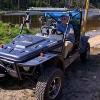
Need to check for cracks in the master cylinder, the way mine was mounted, the banjo nut was in contact with the fire wall. On my 2015, I have the clutch and brake master cylinder on the front of the fire wall and there is a cut out for them to mount on and it should probably be a bit longer for clearance of the banjo nut. - I'll add a photo tomorrow -

Do you want to see a really bad place to have no brakes, copy this partial GPX and drag and drop onto Google Earth  -  https://drive.google.com/drive/folders/0ByQAhs0e-yF9NTdma1FNM3p2OUE?usp=sharing


IMG_20170807x.jpg

IMG_20170807_094939.jpg

Posted

I'll presume you've removed most of the air from the master cylinder.  The usual process of that is to bench bleed the master cylinder before installation.  If you use method A, make sure your pedal pumper keeps their foot on the brake pedal and ride it down to the floor while you open the wheel cylinder bleeder valve.  Tell him not to take his foot off the pedal until you close the bleeder valve.  I make sure I tell my assistant that every time.  My assistant may not know how the bleeding process works.

Method B, in my opinion, is the best followed by method C which is good.  Method C uses a hand operated pump which is less expensive than the setup required for Method B.  I wouldn't use D - to easy to introduce air or contaminants.

Posted

I have an air pump designed for a solder sucker that tested out as 10psi that I use to pressurize a Mason jar that I fill with brake fluid and then, using various means, pump the fluid through the system. I did this from master cylinder, then from the caliper and still really poor brake pedal, finally used some welding clamps and collapsed all the calipers to where the brakes were locked and started pumping fluid from the master cylinder reservoir to the calipers and while the fluid was flowing, also pumped the pedal several times, I did notice that when I pumped, I had air come out with the fluid, after that, I had good pedal, FINALLY!

Next, all the fluid that I recovered was filtered through coffee filters and reused in the system, or dripped or spilled, and now that I'm finished, saved for next time, along with the mason jar and tubing.

Jeff

PS. I do agree that method D from above would tend leave any air in the system because the fluid is going in at a high point with no buffer like the reservoir so the air would just swirl around in the pressure chamber

Join the conversation

You can post now and register later. If you have an account, sign in now to post with your account.
Note: Your post will require moderator approval before it will be visible.

Guest
Reply to this topic...

×   Pasted as rich text.   Paste as plain text instead

  Only 75 emoji are allowed.

×   Your link has been automatically embedded.   Display as a link instead

×   Your previous content has been restored.   Clear editor

×   You cannot paste images directly. Upload or insert images from URL.

  • Popular Now

  • Similar Topics

    • By rdc
      Hope I posted this in the right place. Looking for the left side shaft carrier where the rear bearings go for an 1100cc sand viper, I understand an 800 cc carrier will also work. I need the old style two bearing with the spacer in the middle, the new style with just the one wide bearing wont work. If anybody has one I'll buy it right away. my email is [email protected]
    • By Jamie 67
      Why is there 2 different length keys for my tboss 1000?
    • By MilSurpYinzer
      Hey all, I was just wondering what you guys consider a necessary upgrade or spare part to have or mod onto your machine.
      I'm going for a kind of shtf survival rig that's not going to be SUPER heavy and I'm looking at getting:
      A spare belt (I keep seeing this mentioned everywhere I look so it must be important)
      A spare tire and mount( So would I need a jack like one from an old jeep or something else?)
      Tire chains for the winter
      And maybe a cargo bed upgrade so things don't slide out.
      Bumpers because duh.
      I already installed high output lights and have a windshield, roof, back window, and winch. And I outfitted a Molle panel for the back of my passenger seat with extra supplies like food, first aid, and spare mags.
      Any advise on increasing durability, longevity, and having something on hand because it's absolutely necessary would be a plus.
      Thanks so much!
    • By KMP
      We just bought our 1st side-by-side and wanted to get tips on maintenance items we should address immediately for our 2015 Arctic Cat Wildcat Sport 700 XT.  We are truly beginners and welcome any and all suggestions.  Thank you, we appreciate your help!
    • By gridlock
      After three years, my Sector completely died.  Something caused the hot wire under the seat from the charger to disintegrate, so the batteries weren't being charged.  The batteries weren't charging 100% anymore, so decided to convert to lithium.
      As most others have done, I went with 4-48v batteries in parallel, as I believe that will be plenty of amp-hours for my needs, but can always add more if needed.  I went with LiTime wired CAN batteries and mounted their digital gauge on the dash above the current one, which fit perfectly.  I didn't think the existing battery brackets worked well for the new batteries, so made my own out of aluminum L rails, which makes it much more secure (and saves a few more ounces :)).  Since I wired them in a 'balanced' configuration, I had to make all new cables from 0/1 gauge wire and 8mm posts.  I updated the DeltaQ charger to profile 233. Cleaned everything up (I must have vacuumed 20 pounds of dirt!), put it all together and... wham!
      So far, it definitely is better than with the original AGM batteries.  Sustains speed better going up hills, and seems to have plenty of reserve current.  The difference in weight with 4 LiPo vs 8 AGM batteries surely doesn't hurt!
      Thanks to everyone on this forum, but special shoutout to GNFO who was a big help.
      A few questions:
      In the 'any tips' thread, EVSupport mentioned reprogramming the Sevcon to reflect the new discharge curve of the lithium cells, but I didn't see any more info about that or how to do that.  Is there any more info about that?
      Have folks replaced the onboard 12v battery, and if so, with lithium?  I'm not sure why there is a 12v battery; why didn't they just step down the current of the 48v system to provide power to accessories?
      Is there a recommendation as far as charging with the lithium conversion?  As far as I understand, it is better to let lithium batteries discharge somewhat (but not completely) than keep them charging all the time.  What do you think?


×
×
  • Create New...